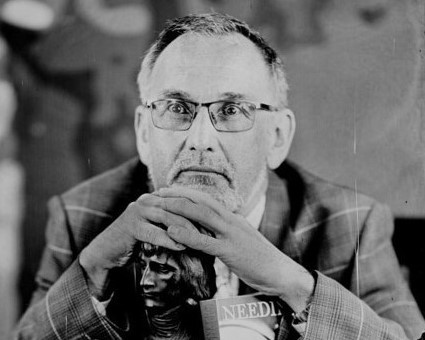
Please welcome my guest, Gareth Williams, a contributor to the Historical Writers Forum’s anthology, Masterworks. I am thrilled to share his thoughts on his wonderful story, The Watcher on the Wall.
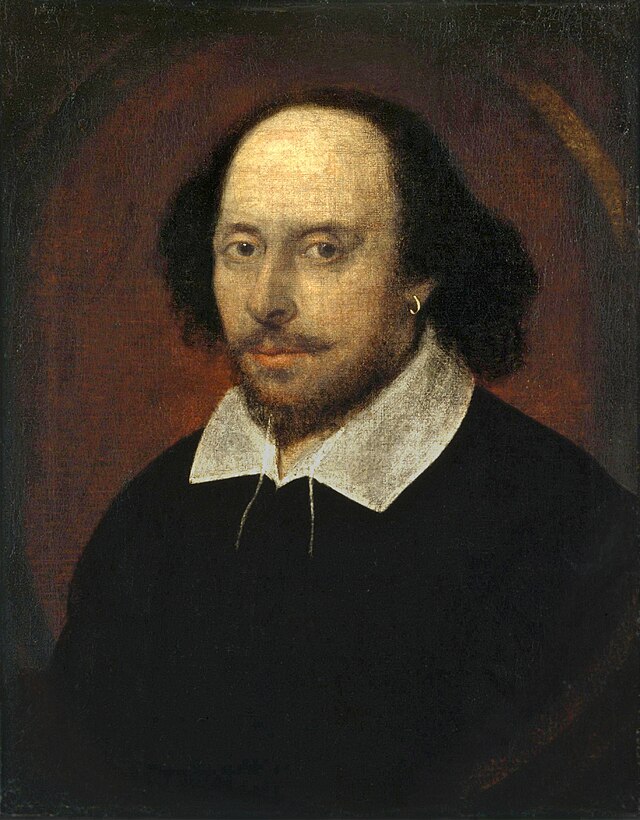
My contribution to Masterworks, an anthology of short fiction inspired by works of art, is entitled The Watcher on the Wall. The watcher of the title is a painting in London’s National Portrait Gallery. Indeed, it was the very first acquisition for that gallery back in 1856. The work in question is usually referred to as the Chandos portrait after the 3rd Duke of Chandos who once owned the painting.
As a result, the portrait speaks to us in language we immediately understand. He understands our context. He is compassionate. Four hundred years of human behaviour have not jaded him. Quite the opposite! His appetite is as acute as ever. He wants to know people, to unpack what makes them tick, to remain as relevant as the day he was painted.
A work by John Taylor, it is believed to be the only portrait of William Shakespeare painted from life, although this view is contested. As a schoolboy, I was introduced to Shakespeare’s plays and for all the difficulties they presented, I became a fan.
I grew up loving all types of history from the dinosaurs to the recent past. I read history at the University of Cambridge and became a history teacher. I still remember the excitement I felt when I first taught a topic that had unfolded in my adult lifetime – the fall of apartheid in South Africa. My pupils were astonished I had a newspaper whose front cover showed thousands of black township dwellers queuing to vote in a democratic election. How did I get it, they asked? I bought it the day it was issued, I replied!
As a writer of historical fiction, I found my connection to Shakespeare grew as I honed my craft. After all, he faced the same challenges that I do when writing his history plays but with far fewer resources to draw on. He leant heavily on Holinshed’s Chronicles, a three-volume British history, as his primary source.
I think this is the point where I should interpose a modicum of modesty. I may compare my research process with that of Shakespeare but I am a making no claim about the quality of my writing by association! If you want to judge my historical fiction, then the Masterworks anthology is an affordable place to start.
Anyway, back to my short story, which features the Chandos portrait of Shakespeare as the main character. Why did I make this choice? Well, I wanted to write a piece for inclusion in an anthology inspired by works of art. More specifically, I wanted to use a painting that meant something to me. Furthermore, I didn’t want the painting to be a mere jumping-off point or background detail. I wanted it front and centre. Pretty quickly, I decided I wanted to use a portrait of someone so famous every reader would know who I was talking about. Shakespeare fitted the bill.
In addition, the connection between the Chandos portrait and the National Portrait Gallery gave me just the frame I needed for my story. I could parade generations of viewers past the painting and interrogate their thoughts. I could use them to reflect changes in society but keep a sharp focus by only relating events that touched the gallery.
Having chosen the portrait of Shakespeare, I spent a lot of time studying his face. I stared into his eyes. I puzzled at his enigmatic expression. Was he judging me? Was he reflecting on his own mortality? Did he have any idea how much influence his plays would have? Was sitting for a portrait his gambit at immortality, something he had already guaranteed with his pen?
As I worried at these questions, my way forward became clear. Let the portrait of Shakespeare act as an avatar, projecting him beyond his death in 1616, to experience the astonishing changes to society that punctuated the next four hundred years. Shakespeare was a product of his time. He is sometimes unfairly criticised for that. How would he have portrayed the suffragettes who damaged paintings, including one in the National Portrait Gallery?
My task, then, was to compose a series of conscious or unconscious dialogues between my portrait projection of Shakespeare and citizens of the nineteenth, twentieth and twenty-first centuries. It is my opinion that Shakespeare was one of the finest observers of human nature who ever lived. Yes, his plays are full of horrors and death, abuse of privilege and casual or callous behaviour. They present us with flawed characters and unequal societies. No wonder his plays continue to resonate! What then would he make of the last four centuries?
My short story is a work of fiction, but just like many of Shakespeare’s plays, I chose to locate it in a real place and explore, directly or indirectly, real events. I chose to place Shakespeare at the centre and reflect his thoughts from the immobile canvas on the wall of the gallery.
How would his thoughts sound in his head, in my head? He often chose to write about the past but the points he was making were for the present (and whether he knew it or not – the future). He did not seek to live in the past but to pull back the curtain to reveal the realities of the present. So, my portrait’s character is perceptive, almost forensic, equipped with an understanding accumulated from some two score decades of observation since his subject’s life ended.
Author bio:
I was born in Essex and studied history at Queens’ College, Cambridge which led to a career as a history teacher and school manager in Guernsey, Oxfordshire and Berkshire. Having retired, I moved to the magical Isle of Skye with my wife Helen and our seventh Pyrenean Mountain dog, a rescue called Sophie. I played rugby until I was forty-eight, and remain a passionate supporter of the Welsh national team. Despite breaking my back in a 400 foot fall down a mountain, I am working my way through all 282 Scottish mountains over 3,000 feet. I am also an ardent skier. I am a keen member of the Skye Ravens mixed hockey team, usually playing in goal during matches.
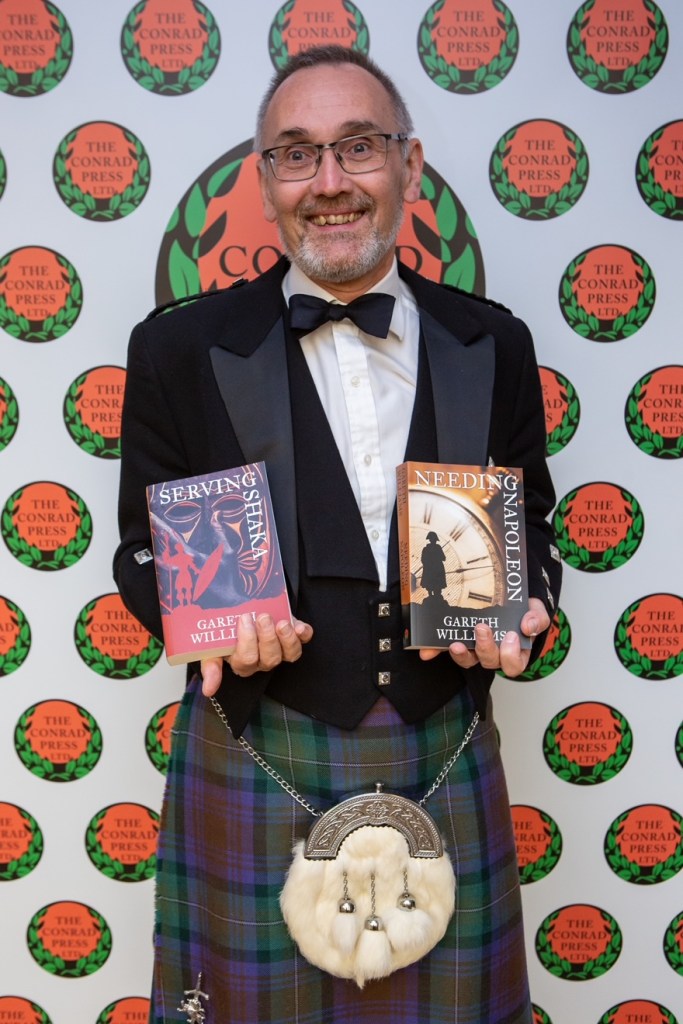
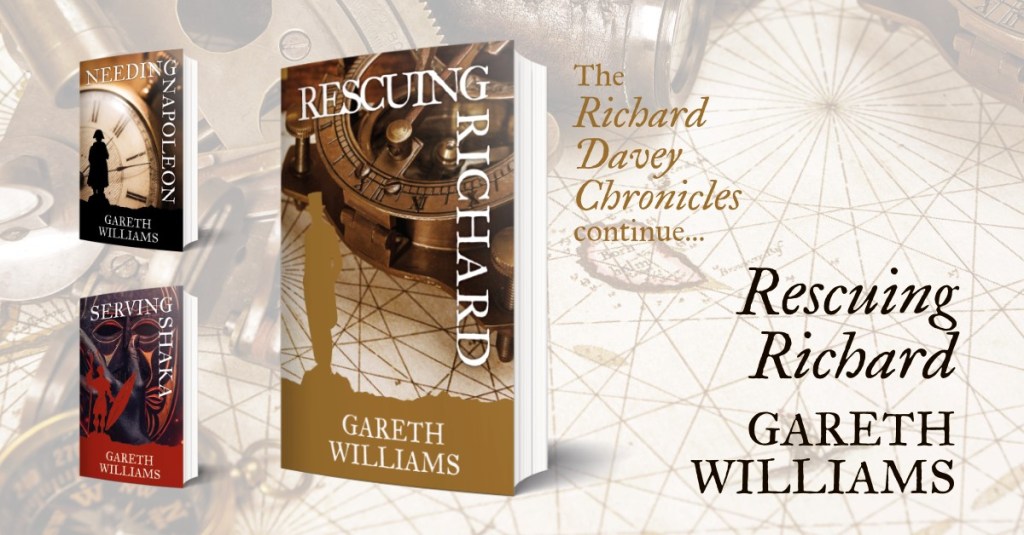
My first novel, Needing Napoleon was published in 2020. The sequel, Serving Shaka, came out the following year. The third instalment, Rescuing Richard is out now. Together this trilogy comprises The Richard Davey Chronicles. Although I am involved in other projects at present, there may be a fourth book in the future.
My WIP is entitled Captain Liar & the Forgotten Flag – the Life and Death of William Augustus Bowles. It is a fictionalised biography of a real adventurer who lived and extraordinary life (and death) during and after the American Revolution.
LINKS ETC:
Alternate History | What if? Historical fantasy novelist’s blog (whatifalternatehistory.com)
Instagram: @garethwilliamsauthor
X formerly Twitter: @garethauthor
Gareth Williams (Author of Needing Napoleon) | Goodreads
About my books:
‘Needing Napoleon’ is a remarkably original feat of imagination: an irresistible adventure that spirits the reader from present-day Paris to the battle of Waterloo and beyond. Can you change what has already happened? As a history teacher, Richard Davey knows the answer. At least, he thinks he does. On holiday in Paris, he stumbles across a curious antiques shop. The eccentric owner reveals a secret Richard dares not believe. Richard’s conviction that Napoleon Bonaparte should have won the Battle of Waterloo could be put to the test. Accurate historical detail collides with the paradox of time travel as an ordinary twenty-first-century man is plunged into the death throes of the French empire.
‘Serving Shaka’ is a dramatic evocation of Zulu nation-building, immersing the reader in vivid battle scenes, poignant relationships and tense political machinations. Having masterminded Napoleon Bonaparte’s escape from St Helena with his friend Emile Béraud in Needing Napoleon, history teacher Richard Davey now finds himself stranded on the African coast. Richard and Emile encounter Shaka Zulu, a leader even more ruthless and ambitious than the former French emperor. Richard’s secret, that he is from the future, is revealed; Bonaparte seeks to outmanoeuvre Shaka; and Emile joins the nascent Zulu army. Buffeted by the birth pangs of nation-building, Richard tries to exert his influence and retain his sense of self, relying on half-remembered lectures from two hundred years in the future.
‘Rescuing Richard’ is a breathless quest that sweeps the reader from the blood-soaked battlefields of Zululand to the corridors of power in Regency London. Richard is astonished when Shaka appoints him to his inner council, where he vies for influence with his friend, Napoleon Bonaparte. Drawn to a feisty, intelligent young Zulu woman, Richard wrestles with his conscience while confronting betrayal and colonial adventurers exploiting the land he is sworn to protect. Having helped equip the Zulu army with artillery, he is sent as ambassador to the court of King George, where he defends Zulu interests while trying to help an old acquaintance escape an abusive relationship.
Where to find my books:
USA:
Amazon.com: Gareth Williams: books, biography, latest update
UK:
Amazon.co.uk: Gareth Williams: Books, Biography, Blogs, Audiobooks, Kindle
 Kathleen Guler
Leave a comment